

Sit up straight. Stop looking down at your phone. Pull your shoulders back. If you have been dealing with neck pain, chances are someone has already given you this advice, and chances are it has not made much of a difference. The posture myth is one of the most persistent ideas in musculoskeletal health, and it leads a lot of South Florida residents to spend months trying to correct how they sit while the actual cause of their pain goes unaddressed. Professional therapy programs at Aries Physical Therapy take a different approach, one that looks past surface-level posture fixes to find what is genuinely driving the problem. South Florida physical therapy built around that kind of honest assessment gets better results because it is working on the right thing from the start.
Posture Is Not the Problem You Think It Is
Research over the past two decades has shown that posture alone is often a poor predictor of who develops neck pain and who does not. People with what clinicians would describe as perfect posture develop chronic neck pain, and people who hunch over screens all day never experience it at all. That does not mean how you hold yourself is irrelevant, but it does mean posture alone is not the explanation. The real issue is almost always load and capacity: how much demand is being placed on the structures of the neck and upper back, and whether those structures are strong and mobile enough to handle it. South Florida physical therapy assessments that focus only on posture correction are starting at the wrong end of the problem.
What Is Actually Driving Most Neck Pain
The neck does not exist in isolation. It sits at the top of a chain that includes the thoracic spine, the shoulder blades, the deep cervical flexors, and the muscles of the upper back, and when any part of that chain stops doing its job, the neck picks up the slack. Consider a South Florida commuter spending ninety minutes each way on I-95. Their neck pain is rarely caused by forward head posture alone. More often, it reflects a combination of stiff thoracic joints, weak stabilizers, and shoulder blades that have lost their ability to move freely, leaving the small muscles of the neck to compensate for all of it. The forward head position is a symptom of that dysfunction, not the cause of the pain, and South Florida physical therapy that treats it as a root cause will keep missing the mark.
Why South Florida Makes It Worse
The South Florida lifestyle creates specific conditions that compound neck and upper back dysfunction faster than most people realize. Long hours behind the wheel navigating everything from the 836 to US-1, desk setups in apartments not designed for remote work, and the hunched-over posture that comes with scrolling through a phone poolside all contribute to the same pattern: a stiff mid-back, overloaded neck, and shoulder blades that have forgotten how to move. South Florida physical therapy providers see this combination constantly, and the residents who respond fastest are the ones who stop chasing perfect posture and start addressing the mobility and strength deficits underneath it.
What a Real Assessment Looks Like
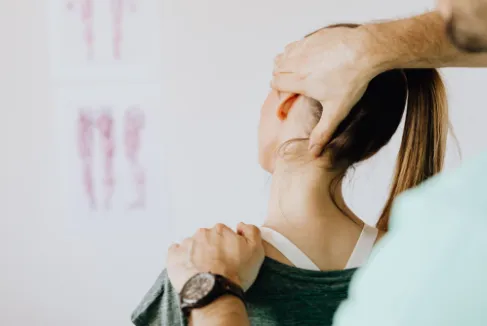
A South Florida physical therapy evaluation for neck pain looks at far more than how you hold your head. It includes thoracic spine mobility testing to see how much rotation and extension is available through the mid-back, shoulder blade control assessment to identify whether the scapulae are moving correctly during arm and neck movement, and deep cervical flexor strength testing to evaluate the small muscles that are supposed to stabilize the head without the larger, more superficial muscles taking over. Most people with chronic neck pain have significant deficits in at least two of these areas, and none of them show up on a posture screen. Treating the neck without addressing them is like fixing a leak by mopping the floor, and it is one of the most common reasons people cycle in and out of South Florida physical therapy without ever fully resolving their pain.
How Treatment Actually Works
Once the real drivers are identified, treatment focuses on restoring what is missing rather than correcting what is visible. Thoracic mobility work loosens the mid-back so the neck stops compensating for its stiffness. Scapular stability exercises retrain the shoulder blades to move and load correctly, reducing the tension that pulls on the cervical spine from below. Deep neck flexor retraining rebuilds the endurance and control of the stabilizing muscles that keep the head balanced without strain. South Florida physical therapy that connects all of these pieces produces durable results because it is correcting the mechanics that created the pain, not just reducing symptoms while the underlying pattern continues.
Does Posture Matter at All?
Posture is not irrelevant, but it is rarely the root cause of pain by itself. The body is designed to move through a variety of positions throughout the day, and problems tend to develop when people stay in the same position for hours at a time or lack the strength and mobility to tolerate those positions comfortably. South Florida physical therapy that addresses load capacity and movement variety will do more for long-term neck health than any amount of conscious posture correction.
Stop Fixing Your Posture and Start Fixing the Problem
Neck pain that has been blamed on posture for months or years without improving is almost always a sign that the real cause has not been found yet. South Florida physical therapy at Aries Physical Therapy starts with a comprehensive assessment of the full cervical and thoracic system, identifies the deficits that are actually driving the pain, and builds a program around correcting them. Better posture tends to follow naturally once the underlying mobility and strength are restored, and that is the difference between a South Florida physical therapy program that produces lasting change and one that keeps you coming back with the same complaint. It is rarely something that needs to be consciously forced.