

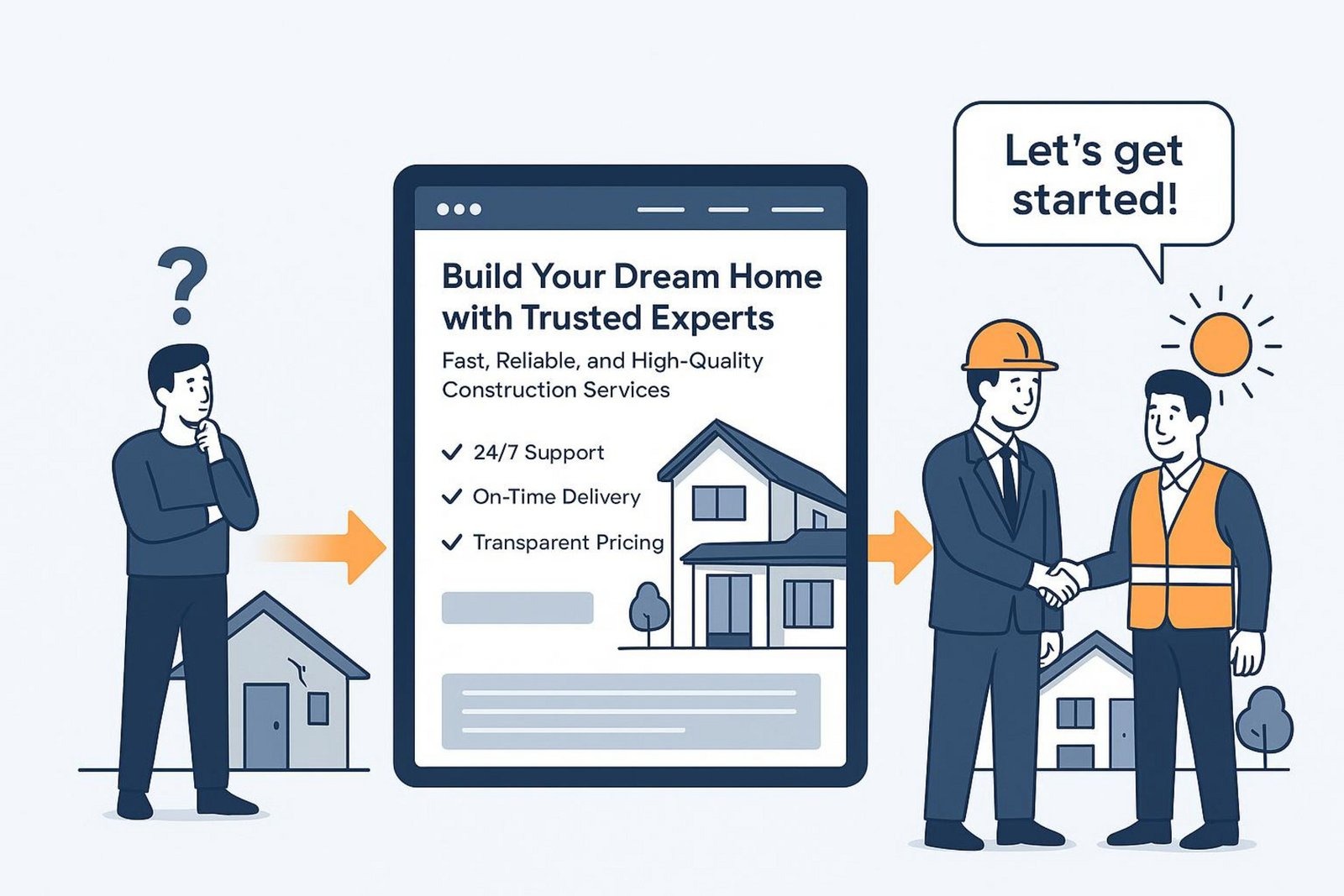
In construction, where blueprints, schedules, and site work compete for attention, your website does more than just sit online. It acts like a round-the-clock salesperson, always ready to attract and convert new clients. Instead of being a static brochure, it can become a powerful tool for winning work.
How does copywriting turn a simple construction website into a steady source of leads? By clearly showing your value, building trust, and prompting visitors to take action, so they move from curious browsers to serious prospects.
This article looks at the practical side of copywriting for construction companies and shows how smart wording can boost your online lead generation.
Today, a strong online presence is no longer optional for construction businesses. Homeowners planning renovations and companies preparing large commercial projects both start their search online. They use Google, compare options, and form opinions before they ever pick up the phone.
If your website does not clearly show your skills and invite contact, you’re losing potential work. This is where good copywriting makes the difference, connecting what you offer with the people actively looking for those services.
What Makes a Construction Website a Lead Generator?
A construction website becomes a true lead generator when it draws visitors in, gives them the right information, and guides them to take a clear next step, such as requesting a quote or booking a consultation. It must go further than listing services and instead create an experience that speaks to client needs and builds trust in your ability to deliver.
Think of your website as your company’s digital representative. It needs to feel friendly, informative, and convincing. When built and written with lead generation in mind, it becomes the central hub for your marketing, helping all your efforts work better together.
Definition of Lead Generation for Construction Companies
For construction companies, lead generation is the planned process of attracting strangers and turning them into people who show interest in your services. These leads are potential customers who have taken an action, such as filling in a contact form, downloading a guide, or calling you after visiting your site. They are no longer just anonymous website visitors; they are named contacts you can follow up with and guide toward becoming paying clients.
The aim is not just a high number of leads, but qualified leads — people whose needs match what you offer, who have a realistic budget, and who are serious about starting a project. Strong lead generation, supported by good copywriting, helps filter out poor fits, protecting your team’s time and effort.
If you’re looking for expert guidance in lead generation for your construction business, BuiltFor Studio can provide strategies that help attract the right kind of leads and turn them into valuable clients.
Why Website-Driven Leads Are Critical for Construction Businesses
Website leads matter a great deal for construction firms for several reasons. They provide a steady, scalable flow of new opportunities. Unlike traditional methods like referrals (which are still important), a well-built website can attract leads at any hour, from any location you serve. This ongoing flow of possible projects supports long-term growth and stability.
Website leads also tend to be more ready to buy. People searching online for construction services are usually further along in their decision process. They are comparing options and actively looking for answers. This makes them easier and quicker to convert. A strong, professional website that clearly explains your skills, shows completed work, and includes testimonials builds confidence. Because construction projects involve large investments, people want to feel sure about who they hire. A clear, well-written website goes a long way in creating that confidence.
How Does Copywriting Influence Lead Generation on Construction Websites?
Copywriting is the quiet driver behind a website that generates leads. It is more than simply putting words on a page. It’s about building a story that fits your ideal client, speaks to their problems, and presents your business as the right answer. Each line and every call to action is chosen to move visitors step by step toward becoming a lead.
Without strong copy, even a visually impressive construction website may underperform. The text is what shows your professionalism, points out what makes you different, and convinces visitors to move forward.
Copywriting Principles That Drive Conversions
Effective copywriting on construction websites follows a few important rules that help turn visitors into leads.
- Focus on the customer: Don’t just list services. Explain how those services help the client. Show how you solve their problems, support their goals, or improve their property. Speak directly to what they care about.
- Be clear and brief: Construction can be complex, so your writing should make things easier, not harder. Avoid too much technical talk and keep your message simple and direct.
- Appeal to emotion: Even in a practical field like construction, emotions matter. People want a safe, attractive home or a reliable, functional workspace. If your copy taps into these feelings, it creates a stronger connection.
Impact of Messaging and Tone on Trust and Credibility
The way you phrase your message and the tone you use strongly affect how people judge your company. A confident, straightforward, and honest tone shows expertise and reliability. On the other hand, unclear, pushy, or error-filled text quickly weakens trust and can drive visitors away. Since your website is often your first contact with a prospect, it needs to give a strong sense of skill and honesty.
By consistently using simple, accurate, and knowledgeable language, you present your firm as a trusted expert. Including references to safety standards, regulations, and your project process in clear terms also supports this image. Keeping a steady, recognizable voice across your pages builds a solid brand identity that feels dependable to potential clients.
Role of Persuasive Calls to Action in Capturing Construction Leads
Persuasive calls to action (CTAs) are central to turning website traffic into leads. These are the direct prompts that tell visitors what to do next, such as “Request a Free Quote,” “Schedule a Consultation,” “Download Our Project Portfolio,” or “Contact Us Today.” Without clear CTAs, even strong content may fail to produce inquiries.
Good CTAs are about more than large buttons. They need the right location, clear wording, and a specific next step. They should stand out visually, use strong action verbs, and state the benefit. For example, “Get Your Custom Project Estimate” is more appealing than “Submit” because it tells the user what they receive. Adjusting and testing different CTA text, colors, and positions helps you find what your audience responds to best.
Key Copywriting Strategies to Turn Construction Websites into Lead Generators
Turning a construction website into a steady source of leads requires a planned approach to copywriting. You’re not just listing what you do; you’re building a clear story that shows your skill, creates trust, and leads people to get in touch. Each part of your copy, from headings to form labels, should support this goal.
When construction companies put these core strategies into practice, they can grow their online presence, attract more qualified leads, and win more work. Spending time on clear communication pays off through new projects and stronger client relationships.
Highlighting Services and Project Portfolios with Customer-Focused Language
When you describe your services and show your project portfolio, your wording should always focus on the client. Instead of simply stating “We offer residential remodeling,” try something like “Transforming Your Home with Residential Remodeling That Fits Your Lifestyle.” This shifts the emphasis from what you do to what the customer gains.
In your portfolio, don’t rely only on impressive before-and-after photos. Add short stories or captions that explain the client’s starting problem, what solution you provided, and the final result. Mention how you met their needs, stayed on budget, or solved unexpected issues. This helps new visitors imagine how you could solve their problems too.
Optimizing Website Copy for Local SEO and Search Visibility
For construction businesses, strong local search performance is non-negotiable. Your copy should be written in a way that helps you appear when people in your area search online. This means using location-based keywords naturally. For example, instead of just “roofing services,” write “roofing services in [Your City, State]” or “commercial roofing contractor in [Your Neighborhood].”
Also include keywords related to your specific services and the issues your clients face. Think about the exact phrases they might type into Google. Make sure these words appear in page titles, meta descriptions, headings, and the main content. A well-written Google Business Profile, with strong descriptions and photos, also supports your local visibility on Search and Maps.
Structuring Clear Value Propositions and Unique Selling Points
Your website must clearly state why someone should choose your company instead of another. This is your value proposition and your unique selling points. Don’t make visitors guess. Spell out what sets you apart: is it your craftsmanship, customer service, green building methods, or fast turnaround?
Place these points where they are hard to miss, especially on your homepage and service pages. Use short paragraphs, bullet lists, and bold headings to make them easy to scan. For example:
- Quality Craftsmanship on Every Project
- On-Time Completion with Clear Communication
- Licensed, Insured, and Safety-Focused Team
Support these claims with testimonials, certifications, or project examples. Clear value statements help people quickly understand why working with you is a smart choice.
Creating Engaging Content Offers and Downloadable Resources
To collect leads, offer something useful in exchange for contact details. Helpful content offers and downloads work very well for this. Ideas include:
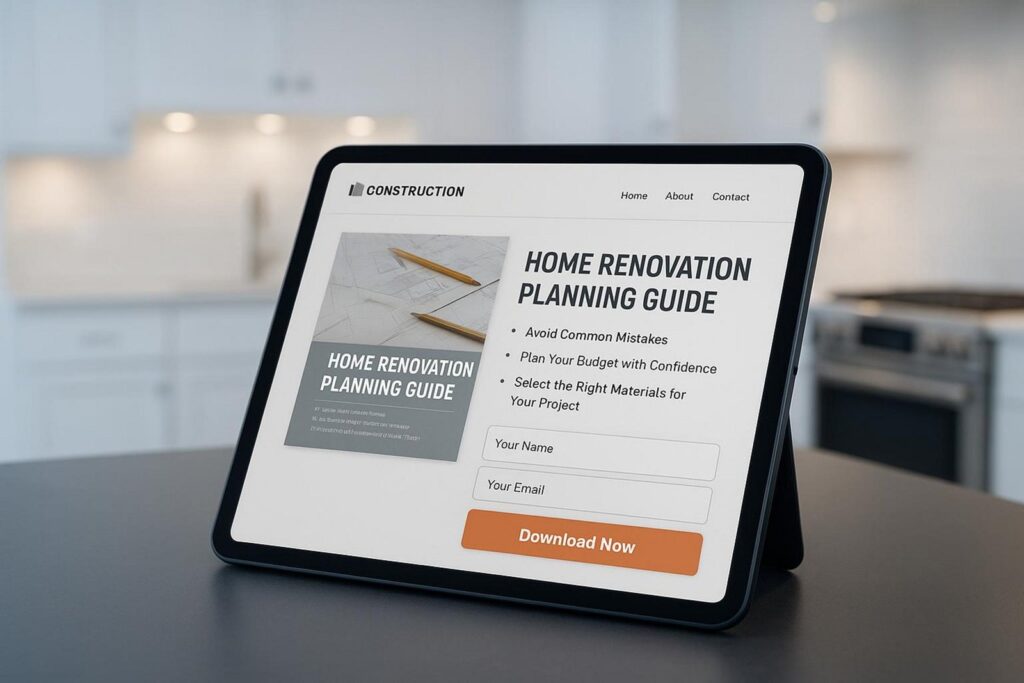
- A “Home Renovation Planning Guide”
- A “Checklist for Choosing a Commercial Contractor”
- An “E-book on Energy-Efficient Building Materials”
These tools position your company as an expert and give visitors real value. Your promotional text for these offers should make it clear what people will learn or gain. For example: “Get Our Free Planning Guide for a Stress-Free Remodel.” Keep the form short and only ask for the details you truly need, so more people complete it.
Using Testimonials, Reviews, and Case Studies as Social Proof
In construction, proof that you deliver good results is essential. People want to see real evidence that you finish projects on time and on budget. Add testimonials, reviews, and full case studies throughout your website. Don’t keep them on a single “Testimonials” page. Instead, place them beside related services and project examples.
Testimonials work best when they are specific and include a name, area, and clear result. Case studies can outline the project type, the main challenge, what you did, and the outcome. By showing positive feedback in your copy, you reassure new visitors that others have trusted and recommended you.
Enhancing Website Forms and CTAs to Maximize Conversion Rates
The last step before someone becomes a lead is often a form and a CTA. The words here matter a lot. Keep forms short and easy to use. Ask only for the information you truly need at this stage. Use friendly, clear labels such as “Tell Us About Your Project” instead of a plain “Message.”
Make your CTAs easy to see and action-focused. Test options like “Get Your Free Estimate,” “Book a Site Visit,” or “Start Your Project Today.” Try out different phrases, button colors, and locations to see which combinations bring in more inquiries.
Common Copywriting Mistakes Contractors Make on Their Websites
Even with good intentions, many contractors make similar mistakes when writing website content, which can quietly hurt their lead generation. These issues can cause your site to feel generic, untrustworthy, or simply weak at turning visits into calls and emails. Spotting and fixing these problems is key to getting better results from your online presence.
The online space is crowded, and small errors in your message can send potential leads elsewhere. By knowing what to avoid, you can turn your website copy into a strong tool instead of a weak point.
Vague or Generic Messaging That Fails to Convert
A very common mistake is using language so broad that it could describe any contractor. Phrases like “We provide quality construction” or “Your trusted local builder” do little to set you apart or show why someone should choose you.
To convert visitors, your copy must be specific and focused on benefits. Explain what “quality” means in your case: Do you use certain materials? Do you have a special process? Do you offer strong warranties? Generic text leaves visitors with doubts and no clear reason to contact you.
Neglecting Local SEO Keywords and Location-Based Copy
For contractors working within a set area, ignoring local keywords is a big mistake. If your site doesn’t clearly list the cities or regions you serve, search engines have a hard time matching you with nearby people searching for your services. This leads to fewer local visits and fewer leads.
Many contractors forget to naturally include place names in their service descriptions, project pages, and contact details. They may also skip adding location info and keywords to their Google Business Profile. Without this focus, it’s harder to reach the local prospects who are most likely to hire you.
Weak or Hidden Calls to Action
A site may have good information and attractive images, but if its CTAs are weak, confusing, or buried, lead numbers will suffer. Common problems include vague text like “Click Here,” CTAs placed at the bottom of long sections, or buttons that blend into the background.
If a visitor likes your services and projects but can’t instantly see what to do next, they might leave without reaching out. Clear and visible CTAs are the direct path from interest to inquiry.
Not Addressing Customer Pain Points or Questions
Another major issue is failing to speak directly to the concerns and questions that potential clients have. People land on your site because they have a problem to solve: a leaking roof, a cramped home, a growing business needing more space. If your copy only talks about your company and doesn’t reflect their worries, you miss a chance to connect.
Many contractor sites don’t answer basic questions like “How long will this take?”, “What might it cost?”, or “What happens if there are surprises?” By bringing up these issues and answering them clearly on your site, you show that you listen, you care, and you have a plan. This encourages visitors to trust you with their project.
Optimizing Website Pages and Content Types for Construction Leads
Having a website is just the starting point. Each page and content type should be written with lead generation in mind. Different pages play different roles as visitors move from first contact to reaching out. Good copy guides them through this path smoothly.
From the first view of your homepage to the details on a dedicated landing page, careful content planning helps every section support your lead goals.
High-Value Pages: Home, About, Services, and Project Gallery
These core pages carry the most weight and need careful attention. Your homepage must quickly grab interest, state who you are, and point visitors toward next steps. The text should be short, clear, and include visible CTAs, such as links to services or your portfolio.
The “About Us” page builds personal connection. Share your story, how you started, your values, and your team’s experience. This helps visitors feel more at ease contacting you. Service pages should describe each service in detail, focusing on benefits and including relevant keywords for search. Your project gallery should include more than pictures: add brief notes explaining the project size, main challenges, solutions, and client satisfaction. This tells a full story of what you can do.
Blog Posts That Attract Qualified Construction Leads
A regularly updated blog is a strong tool for pulling in qualified leads who are still researching. Blog posts let you answer common questions and share useful tips, showing that you know your field. Possible topics include “5 Key Steps to a Successful Kitchen Remodel” or “What Business Owners Should Know About Commercial Building Codes in [Your City].”
Your blog content should be helpful, easy to read, and include keywords people are likely to search for. Link from posts to related service pages or portfolio items, and finish each article with a clear CTA, such as an invite to request a quote or download a related guide.
Landing Pages for Special Offers and Lead Magnets
Dedicated landing pages help you convert visitors who are interested in a single offer, such as a free estimate, a guide, or a limited-time discount. These pages focus on one goal only: getting the visitor to complete the form.
The copy should have a strong headline, short bullet lists of benefits, and one clear CTA. Remove extra links and menu items that might distract people. Speak directly to the problem or desire that the offer addresses. For example, a landing page for a consultation could use text like “Get Expert Answers to Your Renovation Questions Today.”
FAQ and Resource Sections That Build Authority
A good FAQ section and resource library help you look like an expert while answering common concerns. Use simple language and avoid heavy jargon whenever possible.
Include questions about timing, costs, permits, how you handle changes, and what clients can expect at each stage. A resource area might offer glossaries, links to building rules, or articles comparing material options. This helps existing prospects and also attracts new visitors who are researching, setting you up as a helpful guide.
How to Measure the Success of Copywriting-Driven Lead Generation
Once your site is filled with well-written copy aimed at generating leads, you need to track how well it works. Without data, you can’t tell what is performing well and what needs improvement. Measuring results lets you refine your content and keep improving your website as a lead source.
By watching key numbers and trends, you can see how your copywriting efforts pay off and where to focus next.
Lead Tracking: Forms, Calls, and CRM Integration
The most direct way to check copywriting success is to track how many leads your site produces. Count form submissions, calls that start from your website, and any other actions that show interest. Set up strong tracking for every form and connect them to a Customer Relationship Management (CRM) system if possible.
For phone calls, use tracking numbers so you can see which pages and campaigns drive calls. Study which pages visitors were on when they converted and what content they saw first. This gives clear insight into which wording and offers work best.
Conversion Rate Optimization Metrics
Conversion rate metrics show how efficiently your site turns visitors into leads. Key numbers include:
- Overall website conversion rate (visitors who complete a desired action)
- Conversion rates for individual pages
- Form completion rates
- Click-through rates on CTAs
If a service page gets many visits but few inquiries, the copy or CTA might need work. If a landing page converts a high share of visitors, its message and offer are likely strong. Watching and improving these metrics over time leads directly to more leads.
Analyzing Content Engagement and User Behavior
Beyond raw lead numbers, it helps to see how people interact with your content. Tools like Google Analytics can show which pages keep visitors the longest, which posts they read most, and where people leave your site.
Metrics like low bounce rates, longer time on page, and multiple page views suggest that your copy holds attention. Studying user paths can reveal which content smoothly guides people toward forms and which pages lose them. For example, if a blog post draws a lot of readers but very few click its CTA, you might need to adjust the CTA text or placement. Combining this behavior data with lead stats gives a full picture of your copy’s performance.
Does Professional Copywriting Guarantee More Construction Leads?
Professional copywriting has a strong effect on lead generation for construction websites, but it is not a single magic fix. It works best as part of a complete digital strategy that also includes strong design, technical setup, and marketing.
You can think of it like building a structure: the frame and foundation matter, but the finished surfaces and details (your copy) make it attractive and comfortable. Great finishes can’t rescue a badly built structure, and great copy can’t fully overcome serious website issues.
Realistic Expectations for Lead Growth
Good copywriting will improve your website’s ability to attract and convert leads, but expect steady progress, not an overnight flood. Results usually grow over time as search engines index your pages, your brand becomes more familiar, and visitors share your content.
Your market, competition level, current reputation, and the quality of your work will all affect how quickly lead numbers rise. Copywriting gives you a strong message, but outside conditions will also shape the final outcome.
Other Factors That Influence Construction Website Performance
Many other elements besides copy influence how well your construction website performs. These include design and user experience: how fast the site loads, how it looks and works on mobile, and how easy it is to move between pages.
Technical SEO, such as site structure, HTTPS security, and clean code, helps search engines find and rank your site. Professional photos and videos of your projects strongly support your written content in a visual industry like construction. External factors, like reviews on Google and Yelp and your social media presence, also affect how people see your brand. Strong copy acts as the persuasive voice within this broader digital system, helping you get the most from every visit to your site.